
Introduction
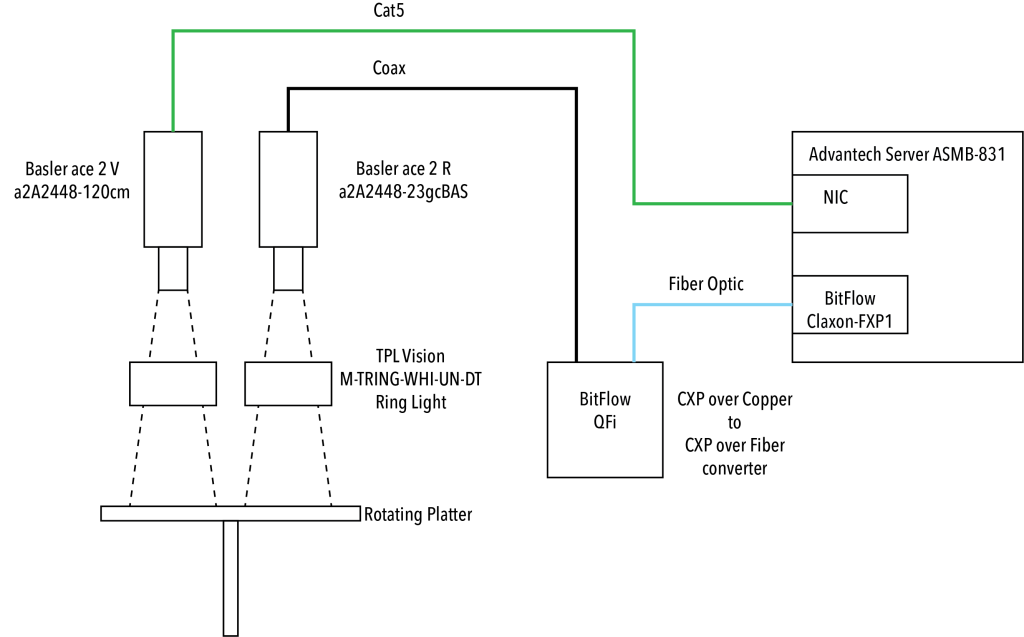
The Advantech-BitFlow Vision 2026 demo shows off several industry-connect machine vision components. The demo starts with two Basler cameras, one CoaXPress (CXP) the other GigE, both using the same sensor. The GigE camera is plugged directly in the Advantech server’s ethernet port. The CXP camera is connected to a BitFlow QFi, which converts CXP over copper coax to CXP over Fiber (CoF). The fiber then goes to BitFlow’s brand new Claxon-FXP1 frame grabber. Both technologies provide video streaming, camera control and power via a single cable. However, the CXP-12 camera runs at 5 times the frame rate.
Announcing
The Vision 2026 demo introduce BitFlow’s brand new single link CoaXPress over Fiber (CoF) frame grabber, the Claxon-FXP1. This frame grabber provides a very low system cost while providing very high data rates and very long cable lengths. The Claxon-FXP1 can acquire directly from single link fiber cameras, or can be used in conjunction with BitFlow’s QFi, a copper to fiber converter, to work with single link copper CXP cameras. By converting a CXP copper camera to fiber, the camera can be located up to several kilometers away from the host PC. The QFi can also provide complete electrical isolation of the camera from the system.
More information on the Claxon-FXP1 coming soon….
The Demo
The video stream from both cameras is fed to a program running in MVTec’s HALCON machine vision environment (HDevelop). The program runs a machine learning algorithm that classifies objects into several pre-trained categories. The core of this algorithm is a neural net in the form of a multilayer perceptron (MLP). The MLP consists of three layers: an input layer with programmable number of input variables (units, neurons), a hidden layer with programmable number of units and an output layer with programmable number of outputs.
Specifically, this demo has trained the MLP on three objects, a washer, a star shaped object and a gear shaped object. The cameras are pointed at a rotating disk with a random mix of these objects. The HALCON program runs these images through its MLP processor and outputs the number of each type of object in the image. The demo shows the total number of each object type found; the objects are also highlight by object color.
The demo runs the same code for both the CXP and GigE cameras. However, the CXP camera can deliver almost 5 times the frame rate. It costs more, of course — but when higher throughput is what you need, Advantech-BitFlow tools make it easy to step up to that performance level.
Components
This demo uses the following components:
-
- Computer – Advantech Server ASMB-831
- Frame Grabber – BitFlow Claxon-FXP1
- CXP Copper to Fiber converter – BitFlow QFi
- GigE Camera – Basler ace 2 R a2A2448-23gcBAS
- CXP Camera – Basler ace 2 V a2A2448-120cm
- Lighting – TPL Vision M-TRING-WHI-UN-DT Ring Light
- Software – MVTec HALCON
More Information
Please email bitflow.sales@advantech.com for more information on this demo and these components